Sisters | Perseverance Street Theatre Company
Images supplied by company
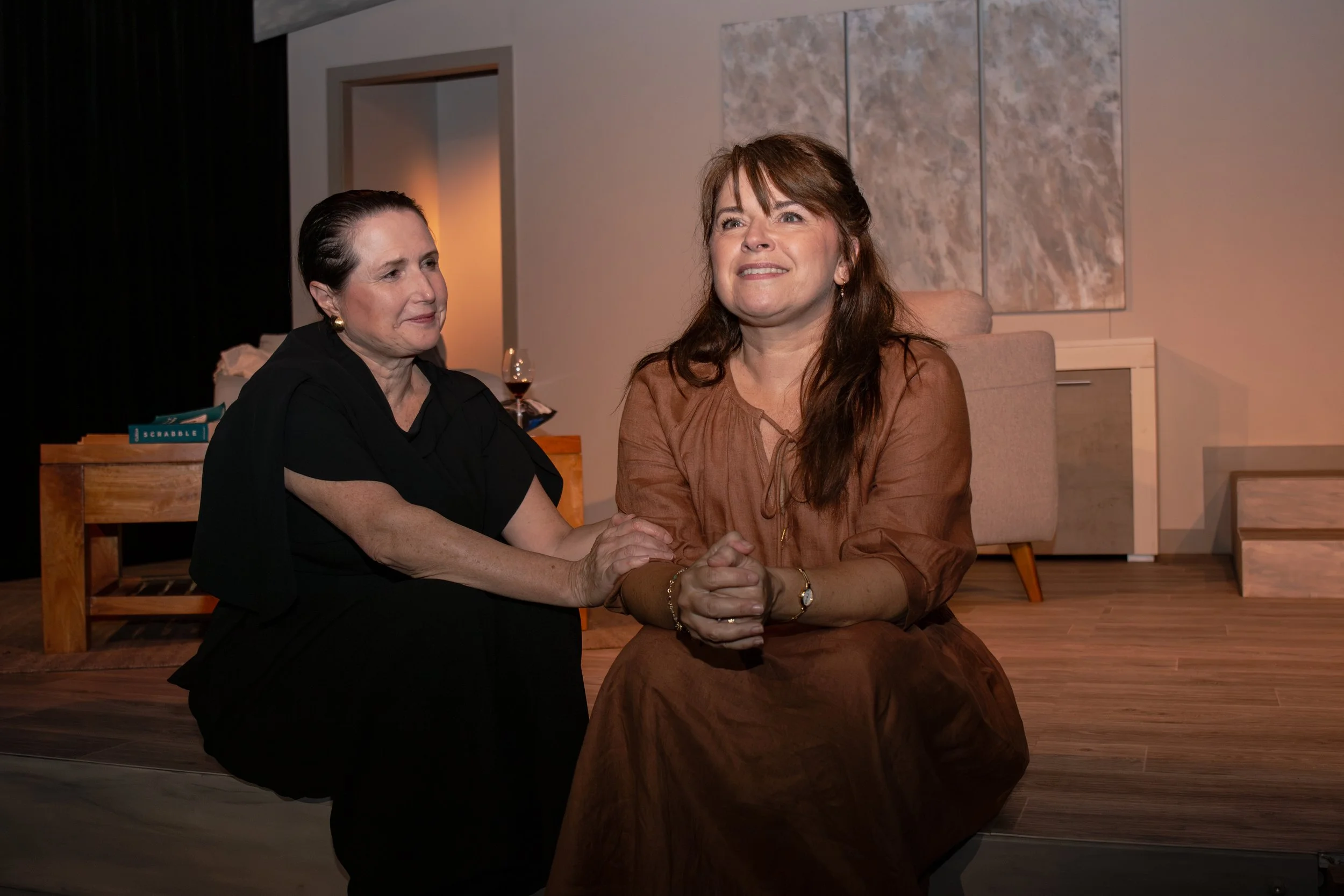
Sisters follows siblings Amy and Andrea as, after Amy fails to show up to their weekend away, Andrea decides to come to her seaside house instead. Upon Andrea’s arrival, Amy’s mood shifts to one of neuroticism, constantly returning to her bedroom to check on her husband who she insists is simply napping. As the play progresses, we learn more about each sister, their relationship, and just why Amy’s husband is still in the bedroom. It’s a solid offer for a mystery-focused relationship drama, but unfortunately Sisters never quite coalesces into anything better than its influences.
There was much that I appreciated about Sisters. The set design is absolutely beautiful, and the use of levels and lighting effectively transitions us between dramatic modes. Sound design, while minimal, remained effective, and added to the scenes in which it was included. The real highlights, however, were Kerith Atkinson and Jo Loth as Amy and Andrea respectively. Dressed in contrasting modern blacks and flowy browns, the pair really sell their dynamic as sisters who, despite growing apart, maintain a fundamental connection. The readily-martyred older sibling and chip-on-shoulder younger sibling contrast felt real, and the pair play off each other believably through wine-drenched reminiscing and bitter accusations. Atkinson deftly plays Amy as a woman aware of her abuse but guilted into inaction, who retreats to imagination and memory to avoid her material realities. Loth’s all-business Andrea is similarly engaging, with her dry comedic input and visible disdain for Amy’s husband adding levity to the situation.
Despite these factors, I think Sisters may not have been meant for me, similarly to last year's The Platypus. Where The Platypus focused on the experience of parenthood, Sisters examines marriage, familial trauma, and what it means to be adult siblings. While these are not unfamiliar concepts, and certainly ones with which I am capable of engaging, none of what Sisters delivered felt impactful to me, and I’m not sure it was necessarily all the show's fault. Certainly, most of the older audience at my showing were gushing about their experience, and it saddens me to be unable to say that I felt the same. It seemed to me that Sisters is a show that will hit very hard for those with certain lived experiences, and may fall flat for others.
The rest of this review will deal heavily in spoilers, so be conscious of this when reading further.
Images supplied by company
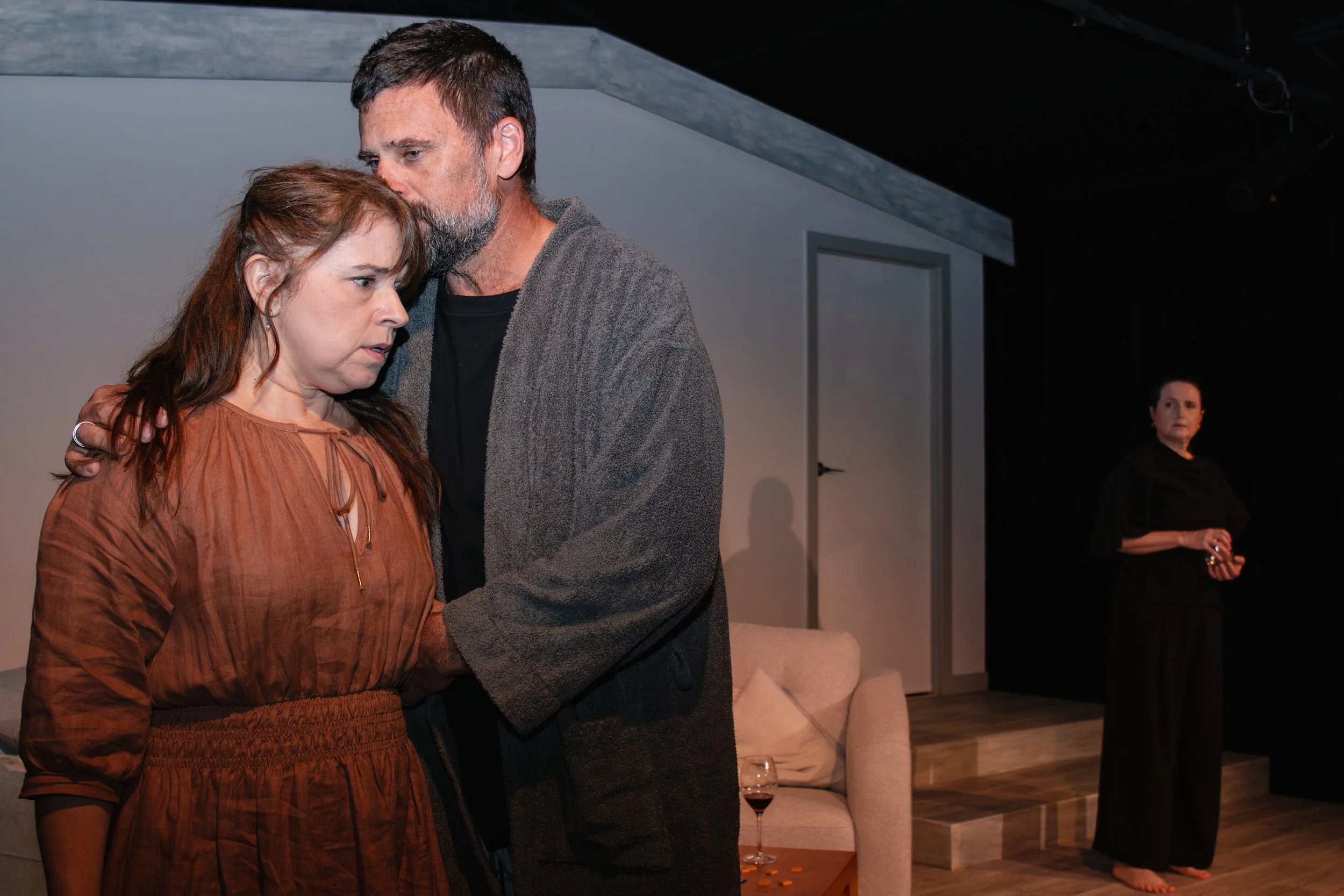
I think my main issue with Sisters was that, ultimately, the text itself is a little more straightforward than I would like - there’s not much complexity or nuance to keep the narrative engaging beyond its conceit. The central questions of the show (Is it okay to kill to escape a bad situation? Does inaction equal complicity?) fall flat when there is so little grey area in terms of who is good or bad, or even just likeable. At about the half hour point, we finally find out why Amy’s husband is yet to appear - he had earlier that day consumed a large amount of medical-grade painkillers, and for much of the play it is murky as to whether this was suicide or murder. It’s a plot that's pretty done at this point - a Christie-style “did he jump or was he pushed” where the more we learn about Amy’s husband, the less we care if she did have a part in killing him. It’s not that an idea has to be new to be good, but if we’re rehashing a plot structure that has been done this many times, something has to make it stand out. To co-writers Hogan and Abbey’s credit, they do put their own stamp on the format - by the end of the play, after the sisters come to the conclusion that Amy is better off without him, it’s revealed that her husband survived his suicide attempt. Amy, unable to finish the murder she had previously set out to do, blanches - primed to return to her abusive status quo. Andrea, in true big sister form, takes the responsibility of serving him a poisoned glass of water and sending him back to the bed he has spent the majority of the play in.
I honestly would’ve been fine with Amy killing him even before we find out the extent of his emotional abuse - he’s framed as a dick from the get-go, and the relationship shows very few positive aspects. At no point was I rooting for him to pull through, though perhaps I am too willing to promote violence as a means to an end. As such, the reverence with which Sisters treats every debate just didn’t affect me as much as I had hoped, which is an issue given these debates are the crux of the show. The scene structure also stays quite repetitive throughout - we get a scene between Amy & Andrea, one of them exits, and then we see either Amy silently struggling while washed with wave imagery, or Andrea telling a story about the girls’ childhood. It all felt a little first draft - I couldn’t really grasp the importance of the surreal transitional scenes, and the exposition seemed like it could have appeared in dialogue with very little difference in effect. It felt like a play unsure of what it wanted to be - halfway between serious familial drama, Coen Bros-adjacent black comedy, and a surreal meditation on abuse and grief, it never quite achieved any of the above, leaving me wishing it had committed more in any direction.
I can imagine this work could open up important conversations and thoughts for many audience members regarding what ‘counts’ as abuse, and for that I commend it. If the concept or promotion surrounding Sisters interests you, I do think it is a show worth watching - it is a well-constructed and well-performed piece of theatre that tackles real themes that, albeit not the case for me, seemingly spoke to many people. I encourage you to find out for yourself if you are one of those people.
Sisters played at Queensland Multicultural Centre from 3-7 July 2026.