Legends (of the Golden Arches) | Joe Paradise Lui & Merlynn Tong
Images: Jessica Wyld
What the hell was Legends (of the Golden Arches) about? Correction: what the Chinese hell was it about? A comedic psychological thriller of a theatrical rollercoaster, it traversed dark themes against a moodboard of Taoism-inspired aesthetics and sensibilities of the afterlife and purgatory. A giddyingly entertaining show, the pacing did not let up. Some will find the subject matter unfamiliar, even niche, for a broader Australian audience unversed in Hungry Ghost Festivals, the rituals of burning hell money and laying out food offerings for ancestral spirits, and the specific griefs of a Singaporean Chinese household or two, but that objection holds no real weight. These were undeniably human stories. It had me surfing a whole gamut of emotions and thinking, whether or not I intimately knew figures like Guan Gong, the Taoist God of War, and Guan Yin, the Goddess of Mercy.
If I were to liken the production to a Singaporean tea time snack, it would be kueh lapis: the steamed, rainbow-layered kind found in wet markets and confectionery shops alike. Sometimes called a nine-layer cake, it’s chewy, and you can really sink your teeth into it. Peeling the layers apart one at a time is a joy that doesn't fade with age, awakening the inner child in adults just as readily as it delights actual ones. This production was just as sticky. Except where a traditional kueh lapis stacks nine layers, it doubled down to eighteen: the levels of Chinese hell, informatively and dramatically unpacked by two actors who clearly knew their way around a good afterlife. It demanded we move through its layers mindfully, lightheartedly even. Plus all that Singaporean Chineseness, front and centre, felt like a slice of home.
Images: Jessica Wyld
But was that really what the title was pointing to? The vigil at the play's centre was for two grandfathers: Chinese immigrants to Singapore who, of all things, found common ground in McDonald's, which opened its doors there in 1979. Merlynn's grandfather was devoted to the Filet-O-Fish; Joe's, to the Big Mac. Two immigrants, one fast-food chain, each finding his own small ritual of assimilation under the same golden arches. Convenient, then, that arches also suggest bridges, and Taoist mythology treats bridges as their own kind of threshold: the boundary between the living world and the realm of spirits, patrolled by underworld guards who lead souls towards judgment. So what exactly did these golden arches bridge? Old world and new? China and Singapore, or Singapore and Australia, where Merlynn and Joe have each since landed? Or was it simpler and stranger than that: American capitalism as its own kind of afterlife, ushering the diasporic in and out through a set of golden gates?
The familiarity, for me, ran deeper than the water under these metaphorical bridges. It started with the accent, Singaporean, unmistakable, and kept unfolding from there. A cloth backdrop layered with images of void decks, superimposed on one another to create a hall-of-mirrors effect, as if each void deck were a portal into another world. An incinerator on stage, the kind used to burn gold ingots of paper, and an assortment of effigies during ancestral vigils, its smoke a familiar fixture of the Hungry Ghost Festival, when families gather at these burners across housing estates to send banknotes to the dead. The 18 levels of hell took me straight back to Haw Par Villa, one of the more beloved (and gruesome) attractions of my '90s childhood, where underworld torture sat, without apparent contradiction, alongside exhilarating flume rides which made my tummy flip and general good cheer. That same doubled register, solemn and celebratory in the same breath, resurfaced in the production's nod to Getai singers, performing karaoke-style for Hungry Ghost crowds.
Images: Jessica Wyld
And when Guan Yin was mentioned, I felt it too, despite being Singaporean Tamil: on Waterloo Street, the Hindu Sri Krishnan Temple sits beside the Chinese Kwan Im Thong Hood Cho Temple, and so many Chinese devotees crossed over to pay respects and burn joss sticks there that the temple installed its own altar and statue for Guan Yin. A small, practical act of welcome that serves as one example of Singaporeanised religious syncretism out of many. Sitting in Cremorne Theatre, held by the palpable pulse of a rapt audience, I realised I already knew this world intimately, down to the void decks themselves, communal spaces where weddings and birthdays and, just as often, wakes were held. I've walked past more of those funerals than I can count.
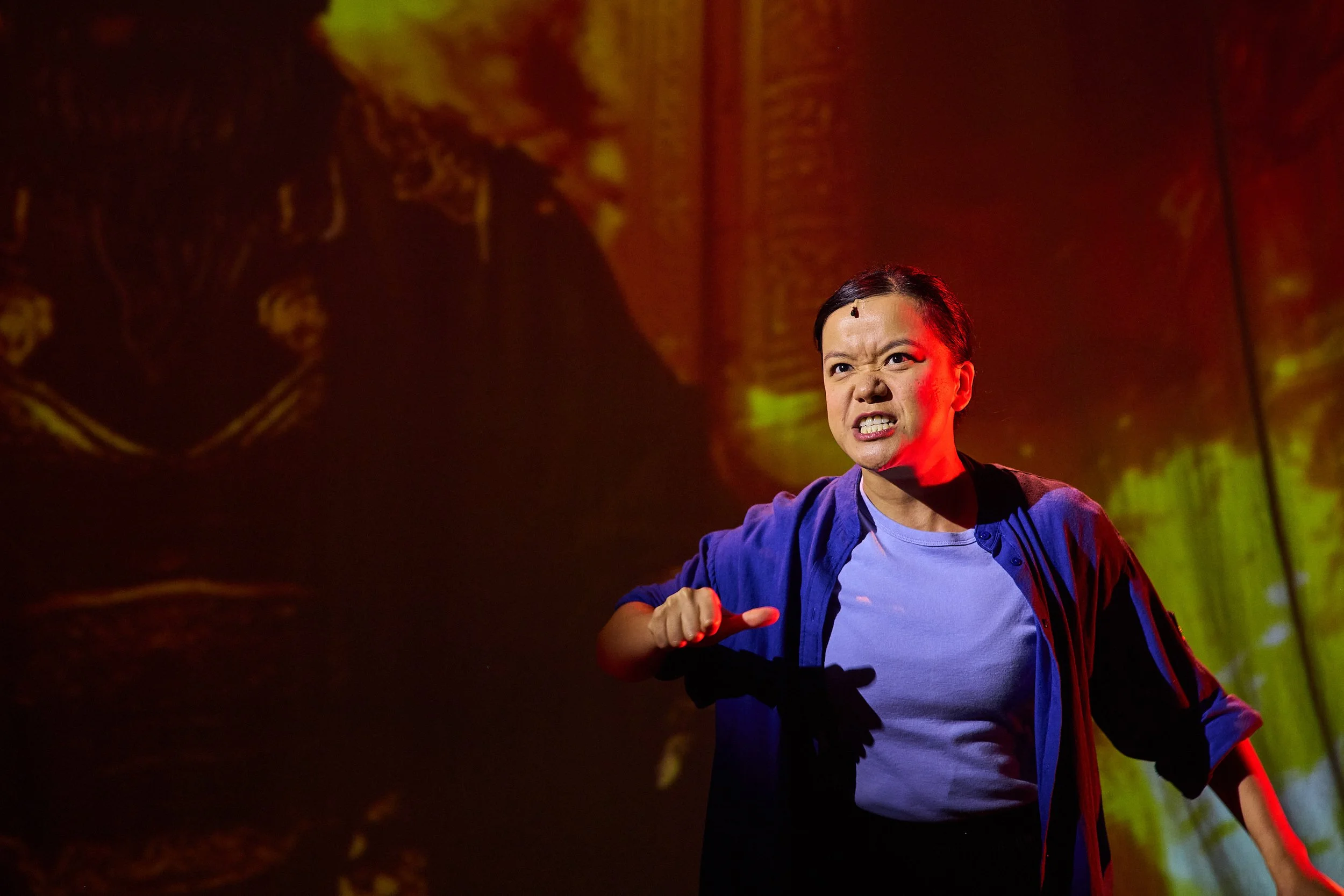
And yet, is knowing a world the same as understanding it? The friendship between Joe Paradise Lui and Merlynn Tong played as an easy one, helped along by the fact that there was no suspension of disbelief required: they called each other by their own names throughout, performer and character collapsed into one. But ease, it turned out, was a thin cover. For Merlynn, the vigil circled the seventh day of her mother's wake and the moment others hoped for her spirit to return. Merlynn instead prayed to Guan Gong, that her mother's spirit stay away, unwilling to summon her back to what may have been an unbearable existence. For Joe, the reckoning was shame: his refusal to complete National Service, Singapore's compulsory conscription, a choice made in pursuit of a different, artistic life in Australia, one he still seemed to carry as a kind of betrayal to all that he left behind.
Images: Jessica Wyld
Watching them, I landed on a revelation of my own, built on two words: reverence and relevance. Joe resisted joining Merlynn's vigil at every turn, refusing to fold the banknotes, feeding them to the burner, and keeping up a steady stream of criticism towards rituals he clearly understood in some depth. But his irreverence felt, to me, less like disbelief and more like armour: a feigned dismissal, a way of keeping these mythologies at arm's length precisely because they mattered too much. The more relevant a mythology is to us, the more fiercely we revere it, even when that reverence shows up disguised as scorn.
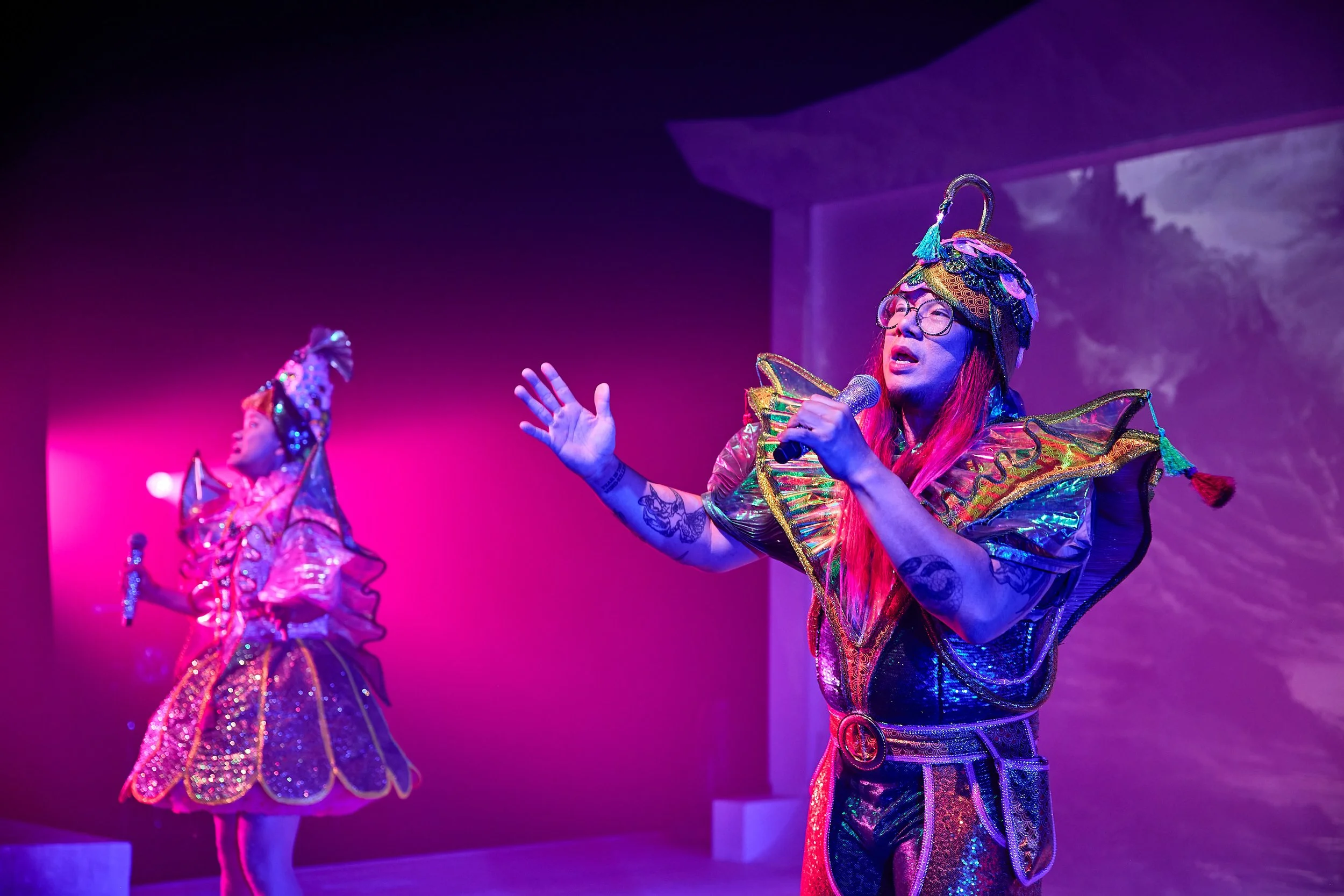
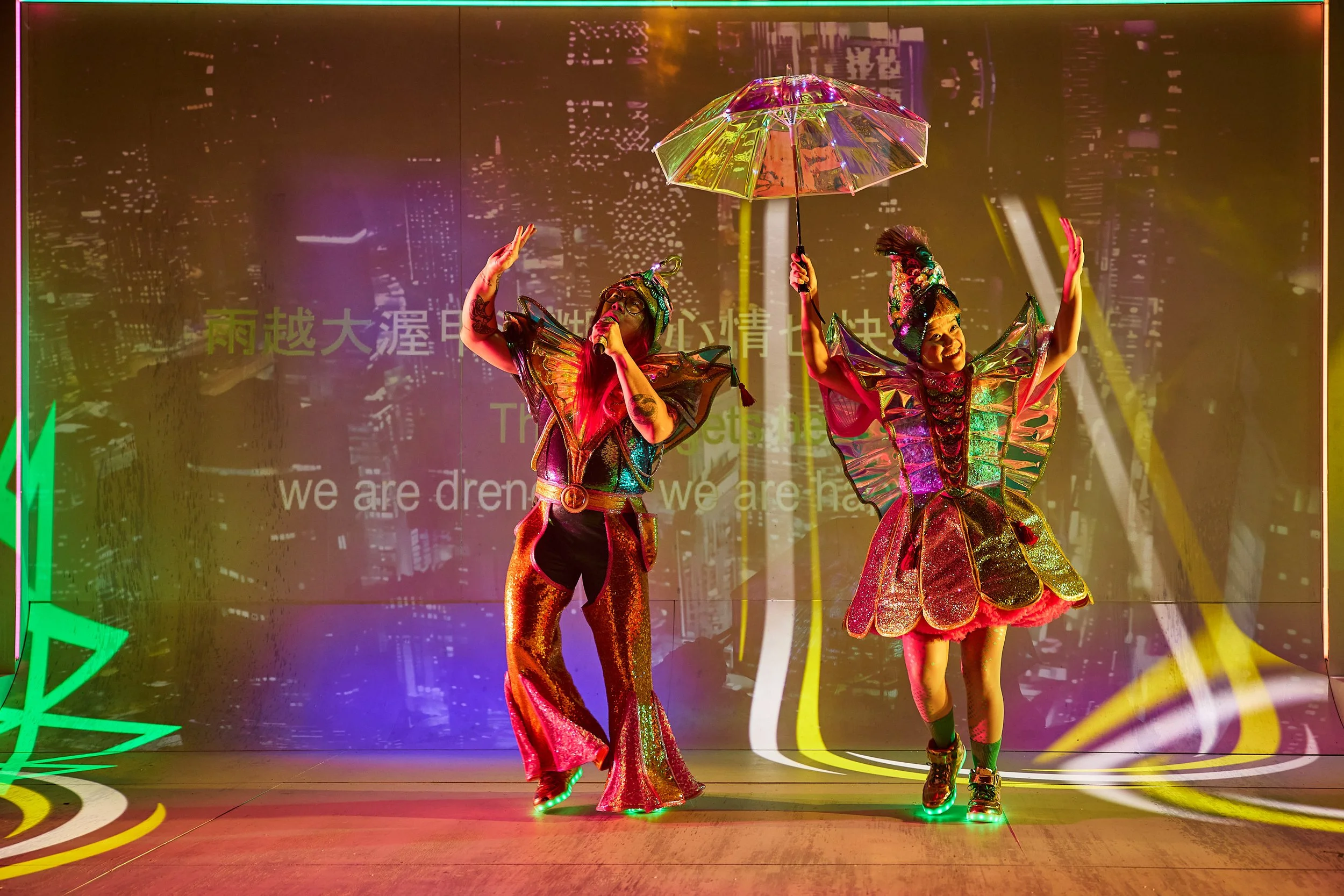
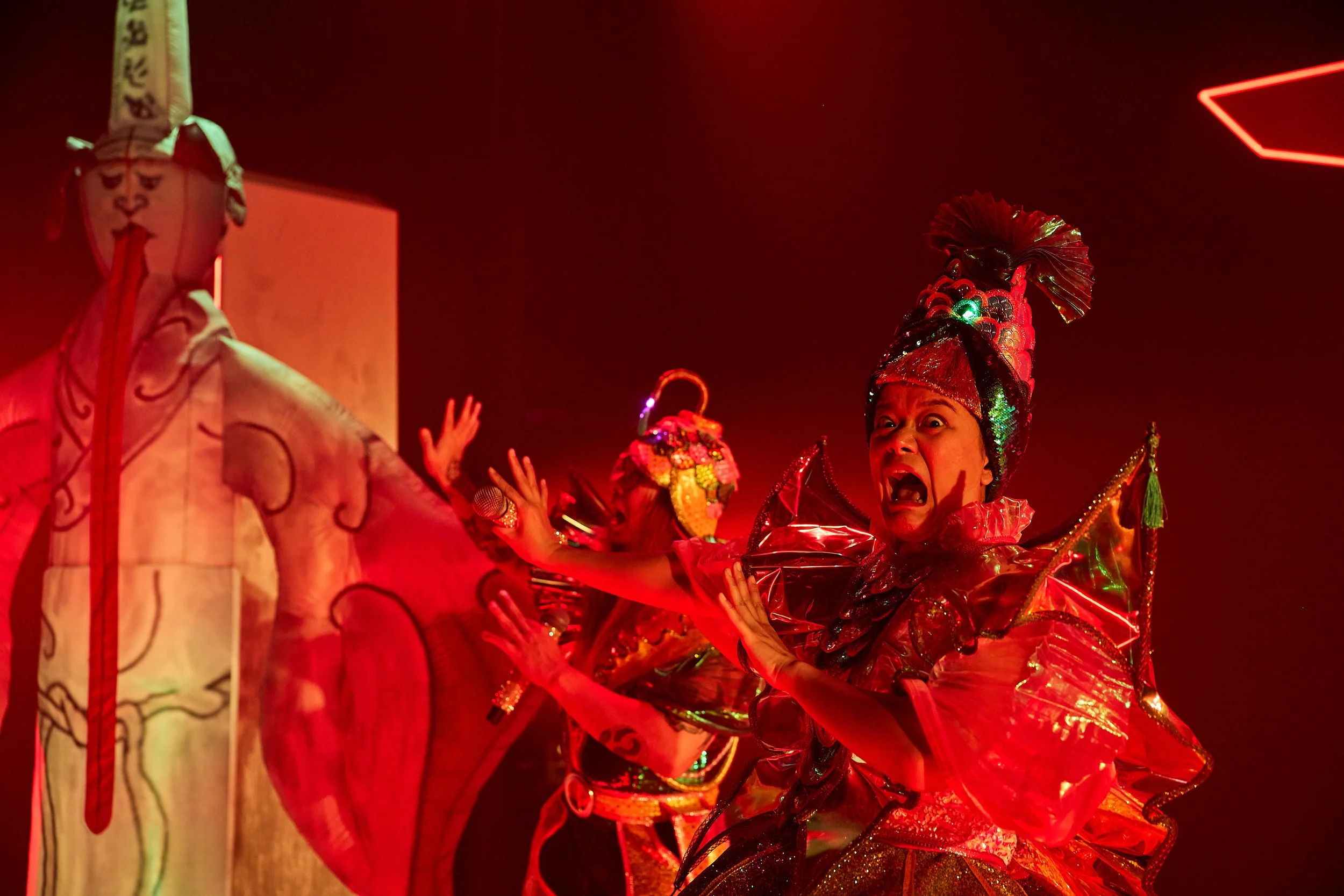
Visually, the production was a riot: garish, gaudy costumes befitting Taoist deities, inflatable gods bobbing on both sides of the stage, a cloth backdrop alive with shifting projections, a soundscape and lighting design that together constructed a microcosm of a much wider, wilder, more colourful mythological universe. And yet beneath all that divine, sartorial excess lay something far more bare, difficult — naked truths that demanded a different kind of courage, and the vulnerability to fully accept them.
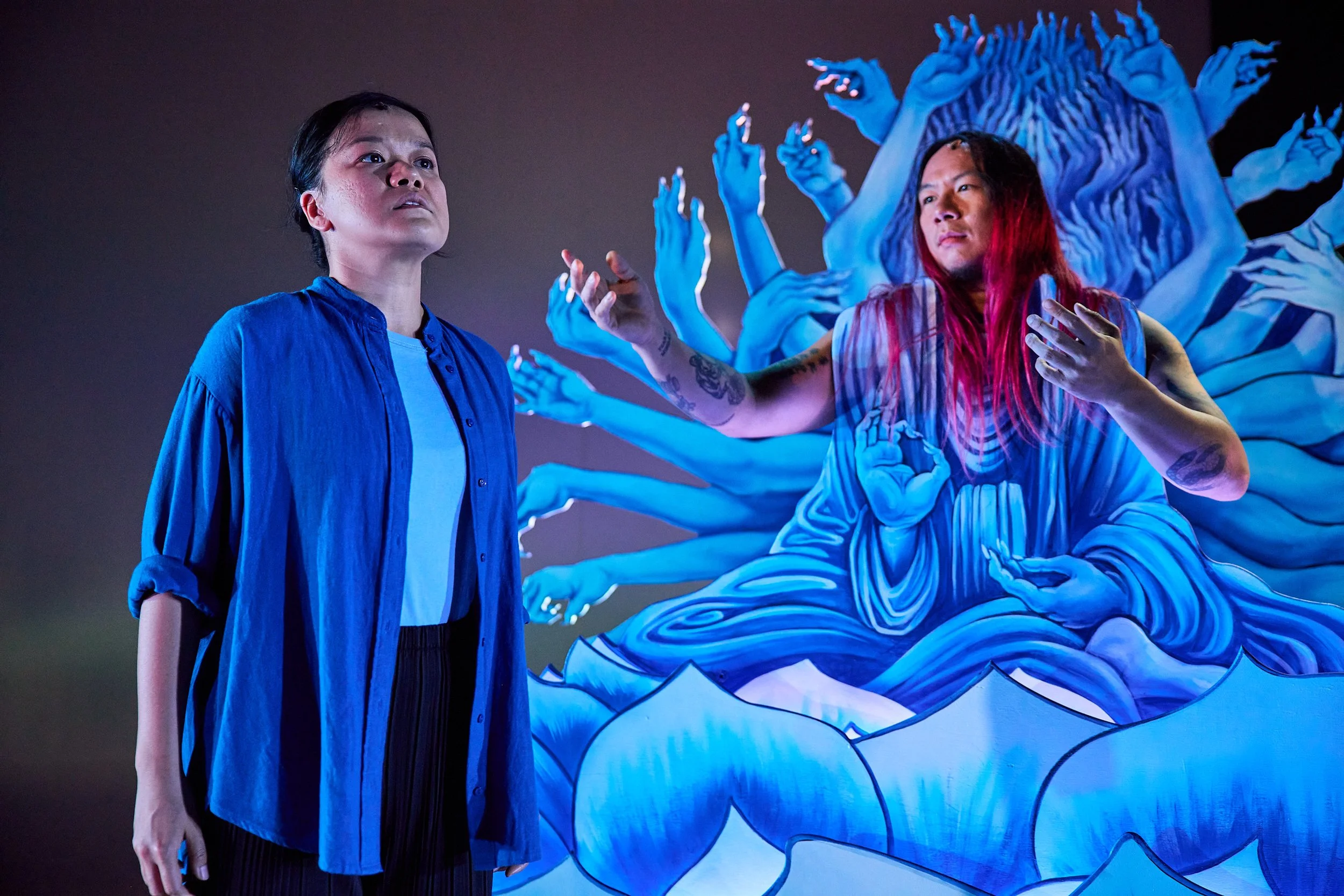
The most poignant moments of all came in the conversations each character had with Guan Yin herself, interviewed, almost interrogated, by the Goddess of Mercy in turn. It was here that both Merlynn and Joe arrived at the same quiet realisation: that compassion was the real saviour, that mercy could not possibly be granted by any god, whether one from mythology or one of their own making. It was already theirs, waiting to be accessed, the part of themselves capable of viewing their own flaws without being diminished by them. One held on to mythology as a lifeline; the other rejected it because it hurt too much to hold. What might free them both was simply the compassion they had yet to offer themselves. These scenes felt surreal to watch and were made all the more so by an arresting set piece in its own right: a wooden, mobile cutout of Guan Yin's many arms, painted in dreamlike blues and lilacs, seemingly drifting above the stage. It truly looked like something conjured rather than built. It was, in every sense, otherworldly, and it was the moment the whole show, sticky as kueh lapis and layered eighteen levels deep, finally came apart in my hands.
Legends (of the Golden Arches) plays 17-20 September at the Cremorne Theatre, QPAC, as part of the 2026 Brisbane Festival.
Images: Jessica Wyld